
On the 20th of January 2012, I attended the launch of the book: Seasonality, Rural Livelihoods and Development, at the Institute of Development Studies of the University of Sussex. Robert Chambers, a torchbearer in the international development profession, was one of the panelists there. A copy of the book was presented to me as a gift by my MA thesis Supervisor, Richard Longhurst, one of its editors. Significantly, it was at this book launch that I developed a research interest in seasonal poverty. The discussion was so intriguing that, for my MA thesis, I decided to focus on seasonal poverty and livelihoods programming.
It was not, however, at this book launch that I first learnt about the effect of seasonality on the lives and livelihoods of people, especially those of limited means. That goes right back to my childhood.
Growing up in the rural area, herding my family’s cattle, I dreaded the rainy season the most, for it was the period of the year where life was unpleasant for me and my fellow young herders. We were exposed to harsh weather, had encounters with snakes, woke up early to plough the fields, had relatively little time to play, were thoroughly beaten if we let livestock stray into our own fields or those of other people and could not go to Harare for the holidays. The rainy season was, therefore, certainly not the best time during our childhood and we couldn’t wait for the dry season (Chirimo)!
Academically, I first learnt about seasonality from Sekuru Conrad Brand, my undergraduate lecturer (retired) and professional mentor, during a lecture on sustainable livelihoods at the University of Zimbabwe. Also, in practice, as a Livelihoods Specialist in the NGO sector, I had witnessed both rural and urban people experiencing seasonal realities.
By definition, seasonal poverty refers to realities that people experience repeatedly at certain times of the year brought about or made more pronounced by marked climatic and non-climatic seasons, which trigger variations in production, employment or livelihood opportunities, food supply, prices of goods and services, disease outbreaks, mortality etc. Seasonal poverty is multidimensional as it manifests in financial, economic, material, social and environmental aspects of poverty.
It is said that the nature of seasonal poverty varies from country to country. I have found it hard to agree with this supposition. Admittedly, climatic and non-climatic seasons can be context-specific, but does that imply that the nature of seasonal realities is contextual too? Unconvinced by this claim, in 2020, I carried out a comparative study of seasonal poverty in Cambodia and Zimbabwe. I have my mentor on Asian realities, Sok Serey Ph.D., at The Royal University of Phnom Penh to thank for making this study possible. This post shares a summary of its findings.
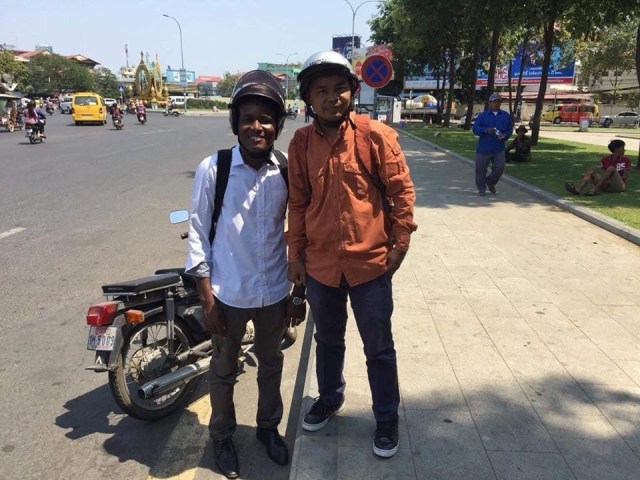
With Dr Sok Serey in Phnom Penh, Cambodia
Comparison of seasonal poverty between Cambodia and Zimbabwe
From the study, I observed that:
- In both countries climatic and non-climatic seasonal realities are, by and large, quite similar.
Climatic seasonal realities common to both Cambodia and Zimbabwe include:
- Seasonal hunger: In Cambodia, seasonal hunger runs from August to November, and about two-thirds of the country’s population experience it each year. In the case of Zimbabwe, seasonal hunger peaks from January to March, and in 2019, approximately 8 million people experienced seasonal hunger. In both countries, this season is associated with food-price hikes, debt vulnerability, mortgaging of assets and exploitation of the poor by people who are better-off, among other realities. Rural communities are the most affected in both countries.
- Seasonal lack of income: which, in both countries, affects poor people the most, since they depend on outdoor livelihood activities such as fishing, vending, brick moulding, handy quarrying and piece work. In Cambodia, the fishing seasons officially runs from October to May such that people who depend on fishing for income are financially deprived during the off-fishing season. Meanwhile, in Zimbabwe, poor people usually experience an acute shortage of income between December and February, and it is common for them to fall into debt.
- Severe public transport challenges during the rainy season. Cambodia has public buses and tuk tuk (auto-rickshaw) as modes of public transport. However, due to traffic jams, the public predominantly uses motorbikes, which are challenging to use during the rainy season. In Zimbabwe, when it rains, private omnibus operators charge exorbitant fares, especially from Central Business Districts to residential areas. One such operator was quoted as saying: “We want to maximise on these rains so that we cash on time. Also, our trips would be few due to rains, as traffic of people travelling will be low.”
- Snake bites: Cambodia has at least 17 species of venomous snakes, while Zimbabwe has four, namely elapids (mambas and cobras), colubrids (boomslang), vipers (puff adder) and atractaspids (bibron stilleto snakes). These species are active during the rainy season. In both countries, snake bites affect poor people the most due to the nature of their livelihoods activities and the challenges they face in accessing treatment.
- Incidences of human diseases: both countries experience outbreaks of diseases such as malaria, diarrhea and faecal infections during the rainy season. In Zimbabwe, for example, the malaria season runs from January/February to May; and in 2020, the country recorded more than 236 365 malaria cases and 226 deaths. Rural communities in both countries are more vulnerable to faecal infections due to the rampant practice of open defecation during the rainy season.
What might be somewhat peculiar to Cambodia and Zimbabwe individually are, for the former, realities induced by floods, and for the latter, realities associated with the winter season, such as for the increase in the prices of blankets and winter wear, and in the incidence of colds and flu.
Non-climatic seasonal realities common to both countries, meanwhile, include stresses (challenges) associated with:
- Festivities – such as Khmer New Year in Cambodia and Christmas, Boxing Day and New Year in Zimbabwe – which have both cultural and religious significance. Money is required for special clothes, meals and gifts, for visiting relatives, and hosting visitors. Poor people struggle to raise this money and often resort to borrowing or mortgaging assets.
- The back-to-school period, which is determined by the school calendar. The beginning of the first school term, October in Cambodia and January in Zimbabwe, is the most financially stressful for families, especially poor ones. Learners starting new grades or levels need new uniforms and stationery in addition to school fees and, in some cases, bus fares. During the back-to-school season, the prices of school uniforms and stationaries usually go up, and due to financial distress, some families borrow money and from illegal money lenders (loan sharks), for the most part, to meet schooling-related expenses.
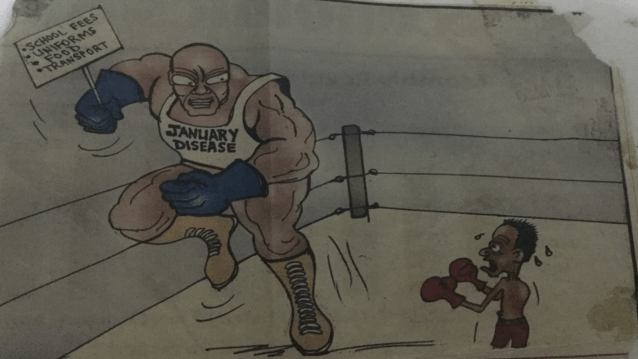
Back-to-school realities, Source: The Sunday Mail, Zimbabwe
What might be rather unique to Zimbabwe are seasonal economic stresses, which occur from late August to March every year. Examples of such stresses are price hikes and limited employment or livelihood opportunities, which are usually caused by agricultural production and festival cycles.
2. The complexity of seasonal poverty in Zimbabwe and Cambodia is similar. Many of the seasonal realities observed in the study interconnect and reinforce each other. In both countries, for example, seasonal hunger weakens the immune system of the poor, making them susceptible to seasonal diseases such as malaria. Furthermore, seasonal hunger fuels food price hikes, which occur when the poor generally lack income for basic needs. Seasonal hunger and other climatic seasonal realities such as snake bites and seasonal diseases, too, coincide with back-to-school and festival stresses.
3. In both countries, seasonal poverty is more pronounced during the rainy season. The rainy season in Cambodia occurs from May to October while that in Zimbabwe runs from October to March/April. The complexity of seasonal poverty highlighted above is more noticeable in the rainy season. Furthermore, it is during the rainy season that most of the seasonal realities observed in the study are severe. Thus, the rainy season is the most difficult period in the lives of poor people in both Cambodia and Zimbabwe.
As the observations highlighted above reveal, the nature of seasonal poverty in Cambodia and Zimbabwe is, to a greater extent, similar in spite of the remarkable contextual disparities between these countries.
Thus, the claim that the nature of seasonal poverty varies according to geographical context is, by and large, not accurate!!
Thank for you reading this post. As promised in my previous post, my next post will address the oft-asked question: Is poverty in Brunei unique and relative? Do look out for it!
Update on my current research activity: I am examining the contribution of the Regional Comprehensive Economic Partnership (RCEP) to the achievement of the Sustainable Development Goal 1 within the ASEAN (Association of Southeast Asian Nations) region. This study addresses the question: Can the RCEP enable ASEAN countries (like Lao People’s Democratic Republic, Philippines and Cambodia), with a high incidence of poverty and those (like Brunei and Singapore) with a low poverty incidence, to make significant strides towards attaining SDG1? I look forward to sharing the findings at a later date.
 Blessing Gweshengwe PhD
Pingback: Is poverty in Brunei Darussalam unique and relative? – Blessing Gweshengwe
Reblogged this on Blessing Gweshengwe PhD.
Pingback: The problem with the $2.15 (formerly $1.90)-a-day international definition of extreme poverty – Blessing Gweshengwe PhD
Pingback: Can access to clean cooking contribute to poverty eradication? – Blessing Gweshengwe PhD