

One afternoon in the early 1990s, a group of pupils at the primary school I attended performed a drama about the Tsotso (twigs) stove (an improved biomass cookstove) to raise awareness about clean cooking. The message was simple: the open fires or simple metal stoves used for cooking in our villages were harmful and contributing to deforestation. The intention was to reinforce what our elders had been taught about the construction, use and benefits of the Tsotso stove. Involving us in clean cooking awareness efforts was likely considered effective, given that we, like most rural children, were responsible for helping with collecting firewood. Who, after all, would not welcome having more time for play and hunting, and being able to arrive at school early and escape the wrath of our stern headmaster – all of which would be possible with the ‘time-saving’ Tsotso stove?
But nothing changed. As far as I know, no households in our community adopted the improved biomass cookstove. Not then, nor in subsequent years. Momentum around the Tsotso stove eventually waned in our community, as it did in many others.
Around 2018, clean cooking began to regain momentum in Zimbabwe. I had the opportunity to contribute to this effort by developing a concept paper to scale up clean cooking programmes and, later, by providing leadership within the sector in Zimbabwe, as well as supporting similar initiatives in Nigeria and Kenya. However, while improved compared to the 1990s, clean cooking adoption in Zimbabwe remains a significant challenge. The issue extends beyond Zimbabwe; it is a global concern (see here and here), with over 2 billion people still using unclean cooking fuels and inefficient cookstoves.
This persistently low adoption of clean cooking does no one any good. If anything, it is worsening poverty within communities. Cooking poverty has become a defining face of poverty, as I shared here and here. In fact, continued reliance on polluting cooking fuels and inefficient cookstoves is not only deepening cooking poverty but also perpetuating poverty in all its forms, since the multiple dimensions of poverty are interconnected and mutually reinforcing, as we discussed here. For commercial companies, it is fuelling credibility and integrity concerns about carbon and SDG credits from clean cooking initiatives, putting capital flows and revenues at risk. For governments, it is not only undermining the achievement of national development goals but also placing additional strain on public finances, particularly amid rising debt levels and declining aid flows. For NGOs and their development partners, it is reversing gains and limiting the effectiveness of their development interventions.
High and sustained adoption of clean cooking is therefore non-negotiable. It is a win-win for everyone. However, the adoption of clean cooking does not need to be forced. Measures such as incentives or rewards, threats, peer influence, changes to kitchen cooking arrangements and regulations may support adoption, but they are paternalistic and often have limited effectiveness. Increased monitoring by governments, private companies and NGOs may also improve uptake. In such cases, however, adoption is not organic but influenced by power dynamics and expectations of handouts. What is more, when people know that monitoring is taking place, they may appear to adopt clean cooking; when monitoring ends, they often revert to non-clean cooking practices. The adoption of clean cooking should, therefore, be organic, but how can this be achieved?
One clear approach is to harness human agency. This entails approaching clean cooking from the lens of what people intentionally choose and pursue – a good life, free from all forms of poverty. To pursue such a life, people require, as the renowned Harvard Economist Amartya Sen recommends, the “capabilities” (abilities, substantive freedoms or real opportunities) to do so. Clean cooking plays a significant role in expanding these capabilities, especially since cooking poverty is now the new face of poverty. It not only lifts the poor out of poverty but also prevents the non-poor from falling into it and becoming the ‘new poor’. Clean cooking is, therefore, a shared pathway to a good life. Leveraging this notion, high and sustained adoption of clean cooking becomes possible. The key question, then, is: how?
The answer does not lie in raising awareness of the benefits of clean cooking, which is the predominant approach currently employed by private companies, governments and NGOs. Undoubtedly, the benefits matter and are essential in expanding people’s capabilities to pursue a good life. However, it is not awareness of these benefits that leads to high and sustained adoption of clean cooking. People have been aware of the benefits of clean cooking since the 1980s, and despite significant technological advancements in clean cooking solutions today, adoption, as noted earlier, remains below expectations. What is required, therefore, is to embed clean cooking within the societal pursuit of a good life, grounded in clean cooking solutions relevant to communities’ needs and lived realities, so that it directly contributes to poverty eradication and, in turn, drives organic adoption.
As I blogged earlier here, one of my research priorities for 2026 is to support the organic adoption of clean cooking. I am currently finalising a research article that positions clean cooking as a catalyst for ending poverty in all its forms.
Clean Cooking: A Catalyst for Eradicating Poverty in All Its Forms
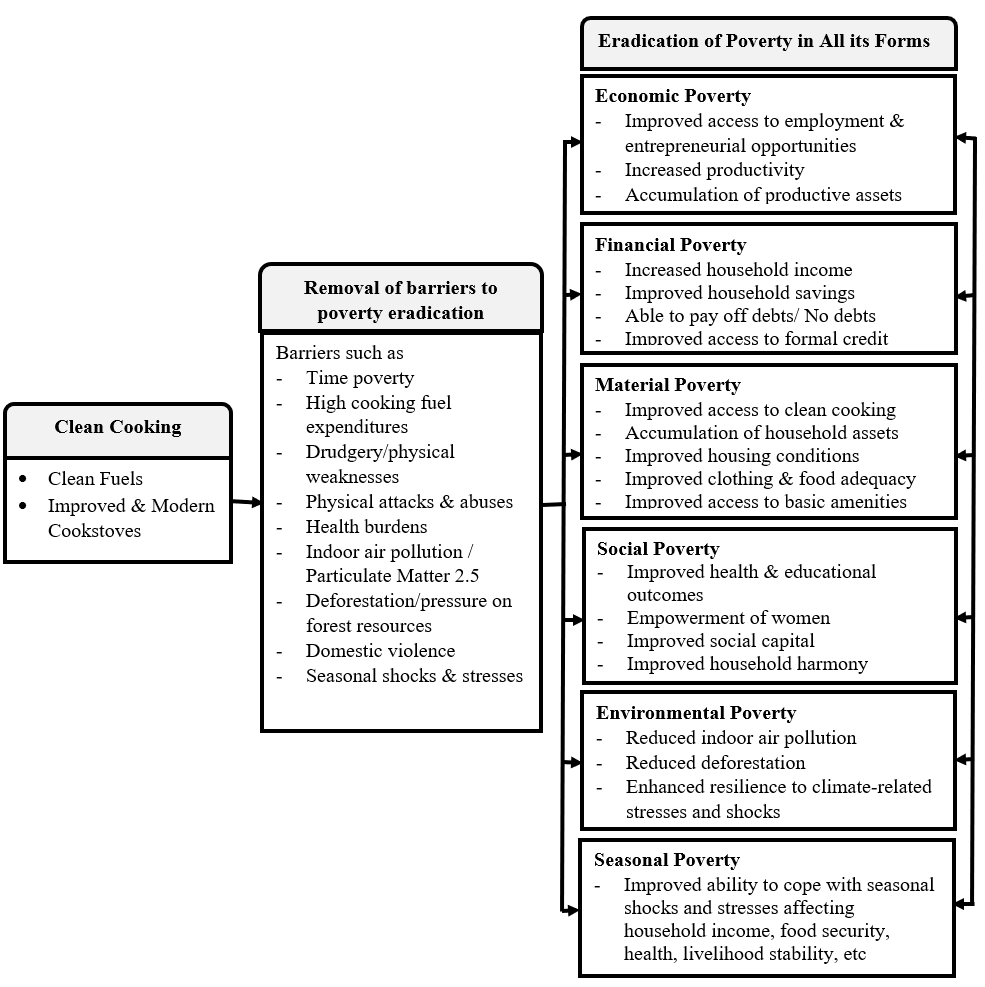
I will then move on to a systematic review of the adoption of improved cookstoves, with a view to strengthening the evidence base on the drivers of organic adoption. Ultimately, I intend to develop a framework for integrating clean cooking into the societal pursuit of a good life, free from all forms of poverty, thereby driving high and sustained adoption.
My mission is to help end poverty in all its forms within our lifetime. As I stressed in a think piece (found here) commissioned by SAGE’s International Journal of Community and Social Development – to inform discussions on ending global poverty at the Second Summit on Social Development in Doha (2025) – unclean cooking is one of the factors that have set back efforts to achieve SDG 1 by 2030. If we embed clean cooking within the societal pursuit of a good life, we will not only achieve high and sustained adoption but also unlock a real possibility of eradicating poverty in all its forms within our lifetime.
 Blessing Gweshengwe PhD
In my experience in rural planning and development, some of the concerns raised about Tsotso stoves were that they won’t make the house warm compared to open fires and that the would make pots wear fast. Therefore, the strategies to encourage the adoption and use of these stoves should take into account these concerns.
Absolutely! Local needs and lived realities should be taken into account, alongside the broader context of promoting a good life, one that is free from all forms of poverty, as this is central to the organic adoption of clean cooking. Thanks for your input and for stopping by!
Pingback: Grounding Clean Cooking in Poverty Eradication for Sustained Adoption: Lessons from My Systematic Review – Blessing Gweshengwe PhD