
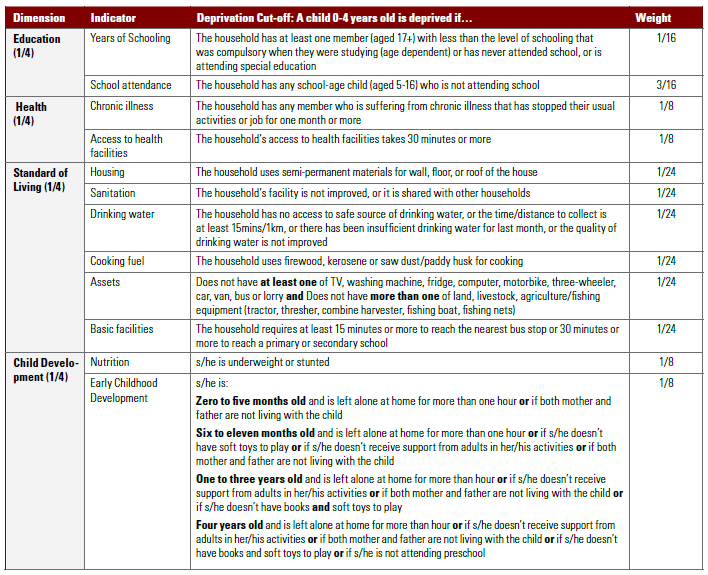
Hearty congratulations to Sri Lanka for pioneering the Child Multidimensional Poverty Index (Child MPI). As described here, the recently developed Sri Lanka Child MPI measures poverty among children aged 0-4. The tool covers four poverty dimensions and twelve corresponding deprivation indicators (Table 1). It considers a child to be multidimensionally poor if he/she is deprived in one or more of the poverty dimensions. For a child to be deemed extremely deprived, he/she should, in addition to being multidimensionally poor, be deprived in each of the indicators.
Table 1, Sri Lanka Child MPI: Dimensions, Indicators & Deprivation Cut-off
In this blog post, I share five reasons why I think that Sri Lanka’s achievement of being the first country to develop and use Child MPI is commendable.
The Sri-Lanka Child MPI acknowledges the multidimensionality of poverty: As I argued in my article here, a sound poverty measure should acknowledge the multidimensionality of poverty. The Sri-Lanka Child MPI does so, as it covers four dimensions and 12 deprivation indicators.
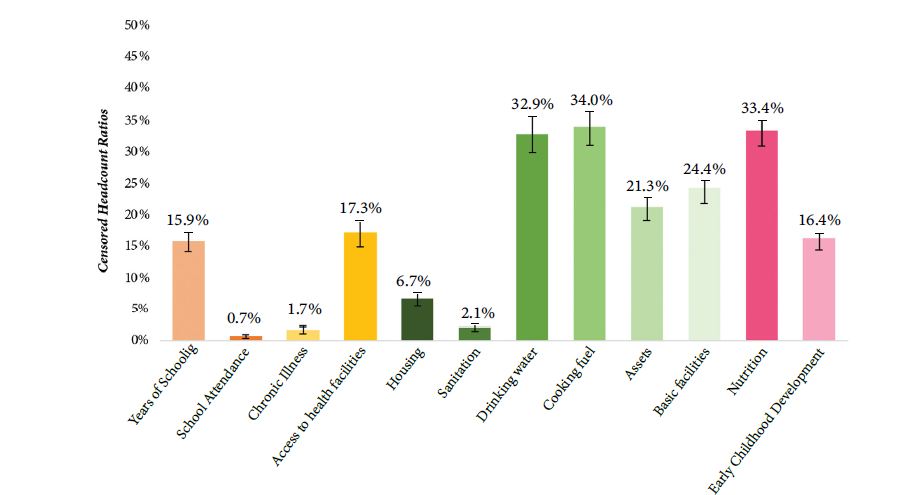
The measure gives a true picture of child poverty within the country: Unlike monetary poverty measures, which do not sufficiently capture the multiple and overlapping poverty realities of the poor, the Sri-Lanka Child MPI captures different and interlocking deprivations experienced by poor children. According to the country’s recent Child MPI report, 4.2 % of children aged 0-4 are multidimensionally poor. The majority of these poor children are deprived in all dimensions and also deprived in cooking fuel, nutrition, drinking water, basic facilities, assets and early childhood development, respectively (Figure 2).
Figure 2: Percentage of children aged 0-4 who are CMPI poor and deprived in each indicator
The Sri Lanka Child MPI is an effective policy tool, which would undoubtedly be essential for crafting, implementing, monitoring and evaluating child poverty eradication policies as it provides key information on the nature of child poverty in the country. By way of illustration, the tool points to the need by Sri Lanka’s government to focus attention on children who are multidimensionally poor and deprived in each indicator. As the Sri-Lanka Child MPI report indicates, in order to reduce child poverty, the country needs to focus on policies that address undernutrition, safe drinking water, access to basic facilities and preschool deprivations.
The country has fulfilled the Sustainable Development Goal (SDG) 1 requirement, which calls for the elimination of all forms of poverty across all age groups and based on national poverty definitions. Countries have, for the first time, committed to specifically and directly eradicating child poverty. Sri Lanka has taken the lead: its Child MPI tool clearly defines what child poverty within the country entails and using this tool, the country is determined to directly tackle child poverty.
Thanks for stopping by!


Pingback: Why are Sri Lanka’s efforts to develop Child Multidimensional Poverty Index commendable? – Blessing Gweshengwe PhD
Pingback: Why should the corporate world embrace the Business Multidimensional Poverty Index? – Blessing Gweshengwe PhD
Pingback: Child Poverty: The Global Crisis Hiding in Plain Sight – Blessing Gweshengwe PhD