
Poverty, as shared in our article here, is one of the defining challenges of our time. Governments, NGOs and other actors are committed to eliminating poverty, and they take stock of their poverty eradication efforts annually on the International Day for the Eradication of Poverty (17 October), as I recently blogged here. For this reason, it is crucial to understand how many poor people there are in the world, how they are distributed and if their number is increasing or decreasing. This is the focus of today’s blog.
Number of poor people in the world
Over 1 billion people around the world live in poverty. The 2022 Global Multidimensional Poverty Index (MPI) report indicates that 1.2 billion people in 111 countries lived in acute multidimensional poverty before the outbreak of Covid-19. If the report had covered all 195 countries in the world, it would have been found that even more people live in poverty. Thus, there is no exact figure for the number of poor people globally, but based on this year’s Global MPI report, more than 1 billion people worldwide are poor.
Distribution of poor people
Globally, poverty is most pronounced among children and then among the elderly. Based on the findings of the 2022 Global MPI report, of the 1.2 billion people who were multidimensionally poor before the pandemic, about 50% were children under the age of 18, and 8.1 % were elderly (aged 60 and above).
More poor people reside in rural areas than in urban areas. Almost 83 % of the multidimensionally poor people in countries covered by the MPI report live in rural areas. Poverty is therefore predominantly rural, substantiating what I have shared in a blog post here, in the case of Zimbabwe.
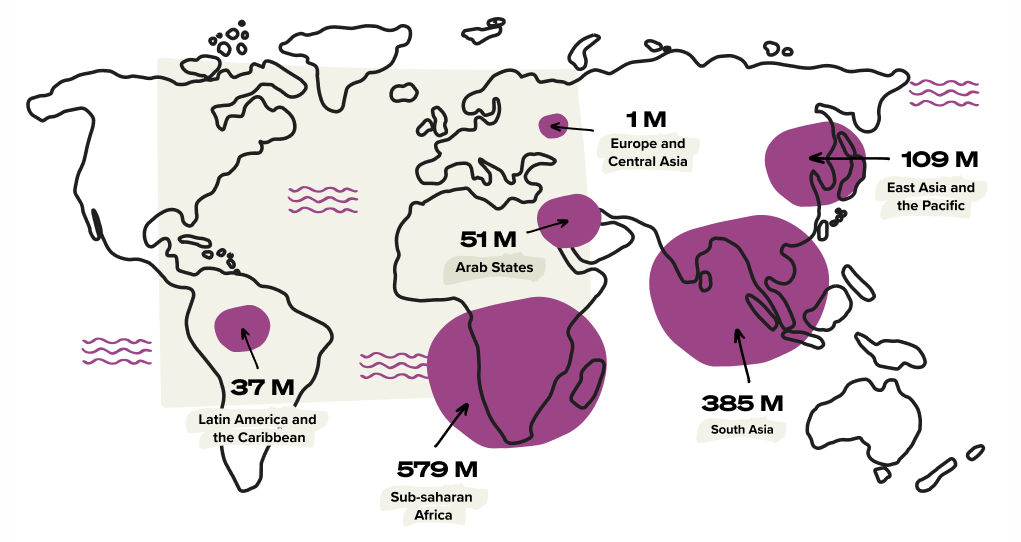
The highest number of poor people is in Sub-Saharan Africa, followed by South Asia, East Asia, and the Pacific. Of the 1.2 billion people living in multidimensional poverty before the pandemic, based on the countries covered by the 2022 Global MPI report, 579 million were in Sub-Saharan Africa, 385 million in South Asia and 109 million in East Asia and the Pacific (Figure 1).
Figure 1: Distribution of multidimensionally poor people as per the 2022 Global MPI estimates
Trends in the number of poor people around the world
There is no doubt that the number of poor people in the world is increasing. This is due mainly to Covid-19 pandemic, food inflation and wars, particularly the one in Ukraine, as indicated in the 2022 Global MPI report and by the World Bank here and here. According to the International Monetary Fund, the pandemic pushed 120 million people into extreme poverty as of 2021. As a result of the war in Ukraine, moreover, millions of people are expected to fall into poverty, as reported here and here . The increase in the number of poor people, especially due to the pandemic and Ukrainian war, is more pronounced among children, as reported by UNICEF here and here.
In summary, the world has more than 1 billion poor people, almost half of whom are children. Many poor people live in rural areas. Sub-Saharan Africa has the highest number of poor people, followed by South Asia. Due to the Covid-19 pandemic, food inflation and wars, the number of poor people worldwide is on the rise.
 Blessing Gweshengwe PhD
These articles have led me to be more interested in quality of life. I’m following and learning a lot !
These articles have led me to be more interested in quality of life. I’m following and learning a lot !
Glad to hear that! Thanks, Edmond.
Pingback: What does the 2023 Global Multidimensional Poverty Index report reveal about global poverty? – Blessing Gweshengwe PhD
Pingback: What will the future of poverty eradication look like? – Blessing Gweshengwe PhD
Pingback: 10 (Sure) Ways of Losing the War on Poverty – Blessing Gweshengwe PhD
Pingback: Ending Poverty by 2030 (SDG1) is out of reach, the World Bank says – Blessing Gweshengwe PhD
Pingback: The 2024 Global Multidimensional Poverty Index Report is out! What does it reveal about global poverty and efforts to eradicate it? – Blessing Gweshengwe PhD