
In our study entitled ‘Understanding poverty in Brunei Darussalam’, I observed that the concept ‘Quality of Life’ is very popular amongst welfare agencies and people in Brunei. This is mainly attributable to Brunei’s vision (Wawasan Brunei 2035) to become one of the top 10 countries in the world with the highest Quality of Life by 2035. However, the meaning of Quality of Life and elements of a high Quality of Life in Brunei are relatively little understood. Furthermore, constructs or theories that underlie the interpretation of Quality of Life in the country are rarely known. Lastly, there has not been any scholarly evaluation of the conceptualisation of Quality of Life in Brunei. For these reasons, in 2016, we carried out a study on Quality of Life in Brunei. The study addressed four key questions: How does the Government of Brunei construe Quality of Life? What do Bruneians describe as high Quality of Life and do the descriptions vary between urban and rural areas within the county? Which theories inform the interpretation of Quality of Life in Brunei? Is the conceptualisation of [a high] Quality of Life in Brunei sound? This post shares a summary of our answers to these questions. For a detailed discussion, you can download our paper, which is open access, here.
Quality of Life as construed by the Government of Brunei
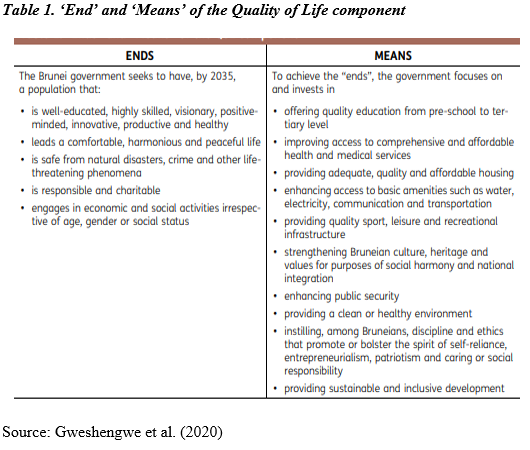
The Government of Brunei construes Quality of Life as having a population that is well-educated, highly-skilled, healthy, responsible, charitable and safe from life-threatening phenomena; that lives harmoniously and peacefully; and that engages meaningfully in both economic and social activities. Our study of the ‘Ends’ (policy objectives), ‘Means’ (policy actions) and ‘Measurement Method’ of the Brunei Vision 2035’s Quality of Life component reveals that the Government’s conceptualisation of Quality of Life is informed by Amartya Sen’s Capability Approach. The ‘Ends’ are the functionings – the valuable states or conditions of life (the beings) and activities (the doings) – that the Government of Brunei wants its people to realise (see Table 1). The Government uses the Human Development Index (HDI) to measure its progress towards achieving the Quality of Life goal. The HDI is based on the Capability Approach. This, therefore, reinforces our observation that the Government of Brunei interprets Quality of Life through the Capability Lens.
High Quality of Life from the perspectives of Bruneians
Bruneians describe a high Quality of Life in various ways (Figure 1). However, they mostly consider it as:
- ‘Having fulfilled basic needs’ – basic needs listed include food, clothing and basic amenities.
- ‘Being financially secure’ – described as having sufficient income, earning extra income (having a side hustle), having savings for the future and unforeseen events, having no debts, and earning a ‘legitimate’ income (honest income permissible by God).
- ‘Being well educated’ – having the highest academic qualifications (graduate and postgraduate degrees) that enable one to secure a well-paying and permanent job and be highly regarded in society.
- “Having a well-paying and permanent job” – that is, having a job that ensures an adequate and stable income.
- “Living comfortably/No hardships” – described as being employed or financially secure, living in a comfortable house and enjoying good health.
- “Being healthy” – that is, being free from serious or chronic sickness, which allows one to access livelihood opportunities, have a long life with one’s children and grandchildren, and stop worrying about medical bills or being a burden to family members.
- “Having a harmonious and happy family” – having peace, unity, love and joy in a family.
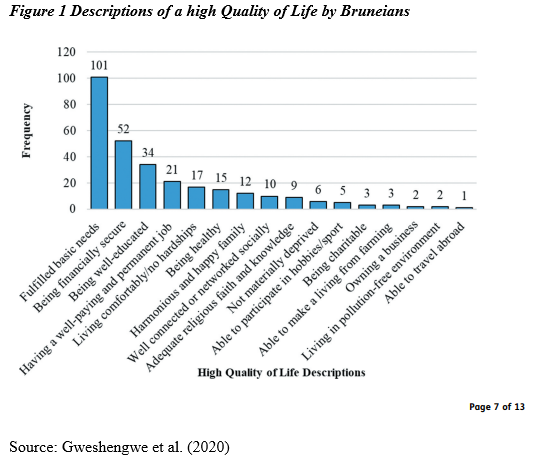
With the exception of ‘having fulfilled basic needs’, which was expressed through the lens of the basic needs, the people of Brunei construe a high Quality of Life in the space of functionings, a key component of the Capability Approach.
As regards the urban-rural comparison, what constitutes a high Quality of Life is, by and large, the same between urban and rural areas within the country. We were expecting this phenomenon in our study, considering that the meaning of poverty in Brunei is, to a greater extent, similar in both urban and rural areas. Also, Brunei is one of the richest countries in the world. According to Shucksmith et al. (2009), urban-rural differences in terms of Quality of Life are less marked in rich countries.
Evaluation of Brunei’s conceptualisation of [a high] Quality of Life
A sound conceptualisation of Quality of Life is that which satisfies Cummins’ (2005) four principles for conceptualising Quality of Life. The first one holds that Quality of Life is multidimensional (covers all aspects of human life) and is determined by personal and contextual factors. The second principle is that Quality of Life elements are common across society. The third principle is that Quality of Life is a phenomenon with both objective and subjective components, which should be incorporated into the conceptualisation of Quality of Life. The objective component denotes how good a person’s life is perceived to be by the outside world, while the subjective component refers to how good one feels one’s life is. The last principle is that Quality of Life in society is improved through self-determination, use of resources, and having a purpose in life and a sense of belonging.
So does the conceptualisation of [a high] Quality of Life in Brunei satisfy the above-mentioned four principles? YES, IT DOES! As Table 1 and Figure 1 reflect, both the Government and Bruneians construe Quality of Life as a multidimensional phenomenon and acknowledge the influence of personal (age, gender etc) socio-economic and environmental factors on it. The Government of Brunei’s conceptualisation of Quality of Life agrees with what Bruneians consider to be [a high] Quality of Life. Hence, there is consensus on the elements of Quality of Life within the country. Furthermore, Brunei’s conceptualisation of Quality of Life includes both objective (education, health, public security, environment etc) and subjective (harmonious and peaceful life) components of Quality of Life. Lastly, the fourth principle is well reflected in both the Government and Bruneians’ interpretations of Quality of Life. In short, therefore, the conceptualisation of Quality of Life in Brunei is sound!
In this blog, I have provided a summary of answers to the questions asked in the introduction. In my next blog post about Brunei, I will be sharing possible reasons why Brunei is doing well in eradicating poverty (as I promised here) or in improving the Quality of Life of its people.


Pingback: Why Brunei Darussalam is successfully eradicating poverty? – Blessing Gweshengwe PhD
Pingback: What does the scholarly article ‘…Poverty from above and below in Brunei Darussalam’ say about poverty eradication in Brunei? – Blessing Gweshengwe PhD