
Since 2015, I have been involved in conducting poverty/quality of life studies and designing poverty eradication programmes in Brunei Darussalam, Southeast Asia. Thus far, I have observed that Brunei is making significant strides in eradicating poverty. The incidence of poverty in the country is quite low, according to the 2010 Brunei Darussalam Millennium Development Report, the 2019 United Nations Human Rights Council Report, ASEAN & World Bank, and Mulyaningsih et al (2020). Brunei attained the United Nations’ Millennium Development Goal 1 target of halving extreme poverty and hunger long before the 2015 deadline, as reported here, here, here and in our article here.
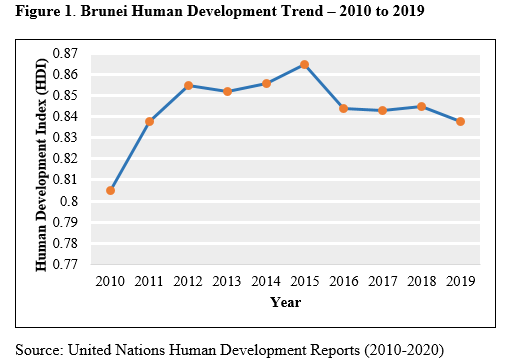
The country is faring remarkably well in the United Nations annual human development rankings. Human development, which is measured through the Human Development Index (HDI), is concerned with “ the lives of people and their well-being”, in the words of Amartya Sen, the Noble Prize Winner. Brunei has, since 2010, maintained an above-0.8 HDI score (Figure 1), which implies a very high level of human development as it is fairly close to 1 (the highest score).
What could be the reasons behind Brunei’s success in eradicating poverty when most countries, especially in the global south, are struggling to do so? In this blog post, I share three observations on this question, based on my experience working on poverty/quality of life issues within the country.
Viewing enhancing quality of life as the ultimate goal
As we shared here, in Brunei, a household is considered to be poor (miskin) if its income covers at least half, but not all, of its basic needs and has a few household assets and weak social capital. It is considered to be extremely poor (fakir) if it lacks an income to cover at most half of its basic needs, in addition to an acute deprivation in terms of household assets and social capital. Despite this interpretation of poverty, the country regards poverty as a quality of life issue that affects both the poor and non-poor. Quality of life in Brunei is officially defined as “having a population that is well-educated, highly-skilled, healthy, responsible, charitable and safe from life-threatening phenomena; lives harmoniously and peacefully; and engages effectively in economic and social activities.” The country’s efforts towards achieving a Zero Poverty Status are therefore being developed and implemented within the realm of quality of life. This approach is not only lifting the poor out of poverty but also addressing the side effects of poverty, which could fuel poverty in the future.
Acknowledging that economic growth alone is not enough for poverty eradication
If economic growth is a silver bullet for poverty eradication, why is poverty still rampant in countries, like the United Kingdom, the United States, India and South Africa, that have experienced remarkable economic development in the past decades? As I made the case in my recent study of the Regional Comprehensive Economic Partnership (RCEP) and poverty eradication in the ASEAN region (forthcoming book chapter) and as has also been argued by the World Bank and other researchers such as Dambisa Moyo (2020), Francisco G. Carneiro et al (2017), and Dullah Muloka et al (2012), economic growth, albeit significant for substantial and sustained poverty eradication, is not, in and of itself, enough for it. By way of example, the 1992-2000 average annual economic growth rate of 6.7% in the Dominican Republic, did not result in a meaningful poverty reduction (Carneiro & Sophie, 2017). Thus, as the World Bank aptly asserts: “ending poverty requires more than growth.”
Brunei concedes that economic growth alone is not sufficient for poverty eradication. Hence, it complements economic growth with redistributive policies. The current long-term development plan, Brunei Vision/ Wawasan Brunei 2035, pays significant attention to economic growth and redistributive policies that are meant to develop a highly educated and skilled population and enhance its quality of life. Owing to its economic growth measures, Brunei is classified by the World Bank as a high-income country. As a result of its substantial investment in the redistributive policies, the country has the most generous and resilient social protection system, which enables Bruneians to enjoy free education and healthcare, low-cost housing, food and energy subsidies, among other aspects (ASEAN & World Bank; Gweshengwe & Hassan, 2019). This acknowledgement that it requires more than economic growth to eliminate poverty is bearing fruit for Brunei, as evidenced by a low poverty incidence in the country.
Leveraging on the power of social capital
Social capital is key for poverty eradication. During fieldwork for our poverty/quality of life studies, I witnessed the influence of social capital, in the form of family institutions and norms, in Brunei’s poverty eradication efforts. As our study of the meaning of poverty in Brunei found, Bruneians are charitable people and this has helped to keep extreme poverty at bay within the country. This is reflected in one grassroots leader’s response to our what-does-poverty-in-Brunei-mean question:
. . .atu tah yang dikatakan nya org tua tua, cari pagi habis pagi, cari patang habis patang makanya besok besok nada lagi lah, atu miskin nama nya tu tapi balum dibrunei tu, payah kan dcari tu. Sentiasa kan orang kan macam membagi bantuan, memengar saja orang, membagi” (. . .as the old folks say [the poor] labour for food in the morning, for morning consumption, and do the same in the afternoon; as a result, there may not be food available for the next few days. That is what it means to be poor, but in Brunei, that kind of poverty hardly exists because people help each other, people are charitable.)
Bruneian families firmly believe that it is their cultural and religious responsibility to assist the needy. Hence, the families are contributing in diverse ways to the country’s efforts towards attaining a zero poverty status by 2035 using their own financial and other resources. Some families are going on to form NGOs. I have had the opportunity to work with such NGOs, some of them are developing household and child poverty graduation models and poverty analysis tools that have the potential to be adopted and used at national level.
In the current race to achieve the UN Sustainable Development Goal 1 target of eliminating all forms of poverty throughout the world, each country has the potential to provide lessons. The three observations behind Brunei’s poverty success story could be lessons for other countries that are struggling to alleviate poverty.
When I was in Brunei, I had the opportunity to volunteer in food-drive initiatives for needy families. I learnt some invaluable lessons that I wish to share in my future blog post on Brunei, which will address the question: What role do food-drive programmes play in the eradication of poverty in Brunei?
Thanks (Terima Kasih) for stopping by!


Pingback: Why Brunei Darussalam is successfully eradicating poverty? – Blessing Gweshengwe PhD
Pingback: Why Brunei Darussalam is successfully eradicating poverty? – Blessing Gweshengwe PhD
Pingback: Can FOOD DRIVE contribute to the eradication of poverty in Brunei Darussalam? – Blessing Gweshengwe PhD
Pingback: What is the level of poverty in the wealthy state of Brunei Darussalam? – Blessing Gweshengwe PhD
Pingback: The story of my PhD on poverty in Brunei Darussalam, a country located in Southeast Asia – Blessing Gweshengwe PhD
Pingback: What does the scholarly article ‘…Poverty from above and below in Brunei Darussalam’ say about poverty eradication in Brunei? – Blessing Gweshengwe PhD