
On the 17th October 2024, the Global Multidimensional Poverty Index (Global MPI) report was unveiled. The release date of the report was, I strongly believe, intentional since October 17 marks the International Day for Poverty Eradication, a momentous day when, as I blogged here, countries worldwide take stock of their poverty eradication efforts and reaffirm their commitment to ending poverty. The release of the 2024 Global MPI can therefore be seen as part of global efforts to highlight the state of global poverty. So, what does the 2024 Global MPI report reveal about global poverty and efforts to end it?
According to the report, 1.1 billion people in 112 countries live in acute multidimensional poverty. This could mean that the world has over 1.1 billion living in poverty. Why is this so? The report covers 112 out of 195 countries, meaning that there are individuals living in multidimensional poverty in an additional 83 countries that are not taken into account therein. In addition, the report focuses on people living in extreme (acute) poverty, excluding those living in moderate poverty, which could mean that the world has more poor people than we actually know.
Of the 1.1 billion multidimensionally poor people, the report indicates that:
- over 50% are children under the age of 18. This unequivocally confirms that child poverty is now a critical global issue, as highlighted by UNICEF here.
- 83.7% live in rural areas. By implication, although urban areas have seen a rise in poverty, global poverty still overwhelmingly affects rural areas. This is a phenomenon that I have also observed in Zimbabwe, as I blogged here.
- 83.2 % live in Sub-Saharan Africa and South Asia. This means that Sub-Saharan Africa and South Asia are home to the majority of the world’s poor.
- 65.2 % live in middle-income countries. Most of the people experiencing acute poverty in the world, therefore, reside in middle-income nations. This clearly challenges the widely held belief that extreme poverty predominantly impacts low-income countries.
Lack of access to clean cooking fuel is the leading form of poverty affecting the poor worldwide. According to the Global MPI report, 998 million of the 1.1 billion multidimensionally poor people use solid fuel such as dung, wood, charcoal or coal for cooking purposes. Unfortunately, lack of access to clean cooking is a critical but often overlooked form of poverty, as blogged here. Addressing this particular form of poverty, as I argued here, significantly contributes to ending poverty in all its forms.
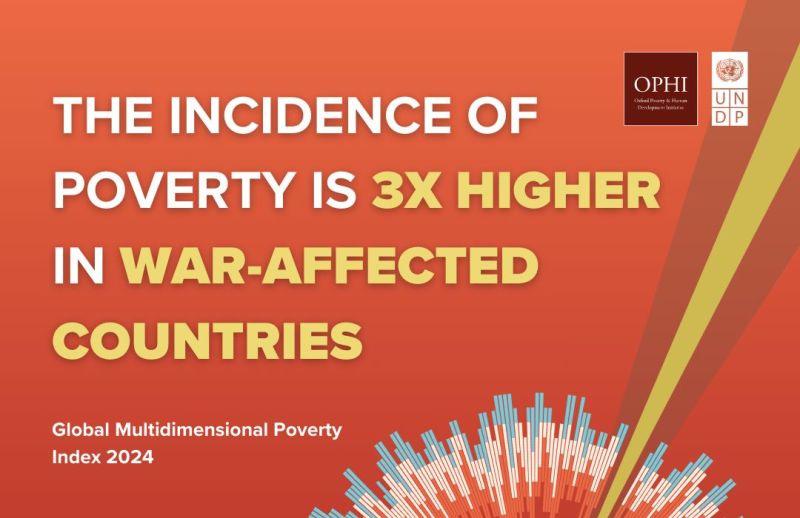
Conflicts are worsening global poverty. As the report reveals, nearly 40 % of the 1.1 billion people living in acute multidimensional poverty are in countries characterised by war, fragility or lacking peace and stability. Conflicts, as the report explains, are worsening poverty by making it difficult for the affected people to meet basic human needs, limiting the future prospects of the affected population, especially youth and children, and reversing poverty eradication gains. Given the surge in conflicts, especially wars, in 2023 and 2024, ending global poverty is increasingly unattainable.
The report indicates that more effort is needed to win the war against poverty. The figure of over a billion poor people reported in the 2024 Global MPI report remains the same as that reported in 2023 and 2022 (see my blog posts here and here). Ending global poverty by 2030, as I explain here, is therefore out of reach. Nonetheless, ending poverty in our lifetime is still possible. We only need to avoid the 10 sure ways of losing the war on poverty that I shared here and reflect on the insights that I shared here on the future of poverty eradication.
As always, thanks to the Oxford Poverty & Human Development Initiative at the University of Oxford and the UNDP for their annual efforts to provide a clearer picture of global poverty. Their efforts are essential in enabling us to assess the progress we have made in the fight against poverty. I sincerely hope and pray, however, that the Global MPI report will soon cover all countries, as this would greatly enhance our understanding of global multidimensional poverty.


Pingback: Nature-based Solutions: A transformative pathway to ending poverty – Blessing Gweshengwe PhD