
As I shared earlier here, ‘Without a deep and nuanced understanding of poverty, we cannot eradicate it.’ In many ways, this echoes the perspective of Strive Masiyiwa, who reminds us that ‘You CAN solve that problem… if you invest in knowing it deeply.’ In my continued efforts to contribute to a deeper and more nuanced understanding of poverty – which include a scholarly article on the ‘Characteristics of Poverty’ that has been downloaded more than 73,000 times since 2020 – I recently submitted my first entry on the conceptualisation of child poverty for the first of the 13 volumes of the Palgrave Encyclopedia of Global Poverty and I am now co-authoring a chapter on child poverty for the Springer Nature Handbook on Poverty and Social Work.
In my more than a decade of contributing to a better understanding of poverty, I have repeatedly encountered the perception that poverty is rooted in mindset and that one can simply ‘think better’ one’s way out of it. This perception is well reflected in the Individualistic Theory of Poverty, which explains poverty as self-inflicted and places the responsibility for poverty on the people experiencing it, arguing that they can only escape poverty through hard work and by changing their thinking. We often hear, for example, the question ‘Why do able-bodied people beg?’, which was also raised to Dr Keetie Roelen, author of The Empathy Fix, during her webinar: Examining poverty reduction and welfare through the lens of empathy and dignity
Although the view that poverty is rooted in mindset is widespread – particularly among some motivational speakers, who argue that people living in poverty should not attribute their situations of poverty to the economy, society or their background, and among those who have not experienced poverty first-hand – it is an inaccurate interpretation of the realities of poverty. Indeed, in The Psychology of Money, Morgan Housel cautions us to “…be careful when assuming that 100% of outcomes can be attributed to effort and decisions.” Writing to his son, he reflects that:
Some people are born into families that encourage education; others are against it. Some are born into flourishing economies; others are born into war and destitution … not all success is due to hard work, and not all poverty is due to laziness. Keep this in mind when judging people, including yourself.
Poverty is a reality, despite effort, discipline and ambition, and we have no shortage of examples of this. Indeed, although many rural people across the world wake up early every day to cultivate land, care for livestock and sustain their households – often to the point of experiencing poverty of little time (time poverty) – poverty remains most pronounced in rural areas, as is the case in Zimbabwe. Although vendors, for example, work long hours with remarkable resilience, many still struggle to attain a decent quality of life. In our communities, we see hardworking and ambitious graduates, some with advanced degrees, unable to secure jobs, struggling to make ends meet, with some even resorting to vending or informal income-generating activities in a quest to survive. Domestic workers, too, often labour under difficult conditions for paltry incomes that keep them trapped in poverty, despite their commitment and sacrifice. Working poverty, or the number of working poor, continues to rise quietly in the background. People pursue opportunities relentlessly, hustling every day, yet some are still unable to attain a decent quality of life.
It is not, therefore, simply the way people think or a lack of effort that drives poverty, but the structural conditions within which people live. Structural conditions are the underlying systems, arrangements, norms, circumstances and realities that shape a person’s ability to access the basic opportunities (capabilities) needed to avoid falling into poverty or to escape it. Such conditions exist at household, community, national and global levels. At the household level, structural conditions include harmful cultural and religious norms and practices, the absence of a reading culture, weak or absent parental guidance and support, orphanhood, parental separation, domestic violence, unsafe or unclean home environments, parental unemployment, low levels of parental education, financial deprivation and intergenerational poverty. These conditions often contribute more significantly to child poverty, as children’s lives are determined largely by the circumstances into which they are born and raised. At community level, structural conditions include harmful societal beliefs and practices, weak community institutions and leadership, limited local economic opportunities, poor infrastructure, under-resourced educational and health facilities, environmental degradation, low levels of social cohesion and social support, crime and violence. Structural conditions at national level include unemployment, weak minimum wage policies and labour protections, collapsing healthcare and education systems, inflation, public debt and fiscal constraints, corruption and weak institutions, political violence, climate change and regressive public policies. At the global level, structural conditions include unequal international trade systems, unfair international financial arrangements, wars and geopolitical conflicts, global economic shocks, sanctions and restrictive migration policies. What is more, structural conditions at household, community, national and global levels often reinforce one another in fuelling poverty.
The argument that poverty is self-inflicted owing to individual actions and behaviours is deeply problematic. Although these individual actions and behaviours could drive and sustain poverty, they are not the root or underlying causes of it. Rather, they are manifestations of flawed structural conditions or some of the ways through which structural conditions produce and sustain poverty. If, for example, there are no books at home or parents do not promote a culture of reading and communities lack libraries, we should not expect children to naturally develop a reading culture. A person raised without a reading culture is also more likely to pass this tendency on to the next generation, such that the cycle continues. Similarly, if communities, for cultural or religious reasons, normalise and celebrate early marriages, these eventually become socially accepted practices. Substance abuse and addiction stem from socio-economic pressures, trauma and weak, or an absence of, parental guidance and support. In the same vein, people do not naturally acquire sound financial literacy; like many other individual actions and behaviours, this is shaped by the environment within which they live.
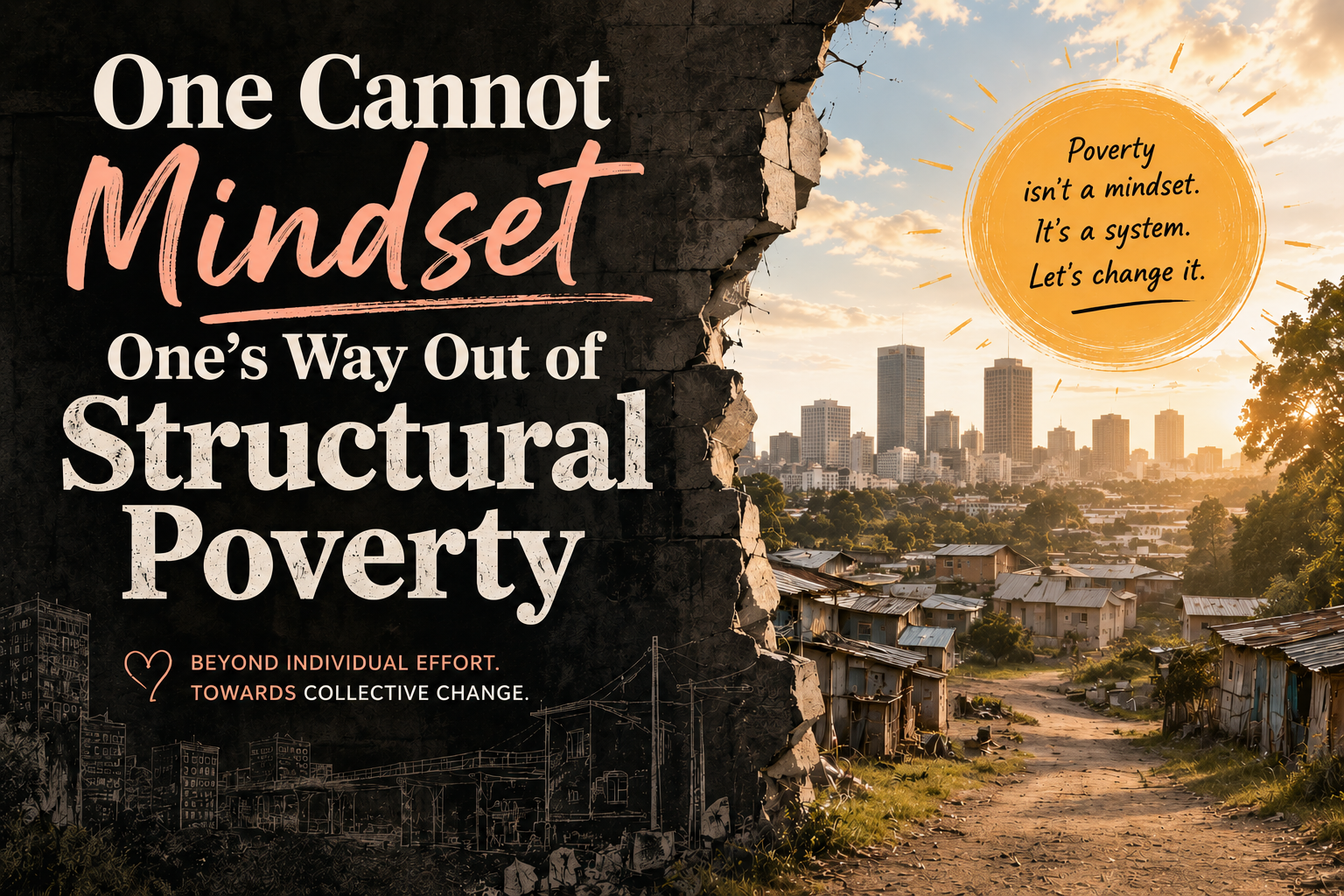
Poverty is therefore deeply rooted in structural conditions, and one cannot simply ‘mindset’ one’s way out of it. The popular notion that ‘I made my way out of poverty’ is often a fallacy. Behind many success stories are structural interventions, opportunities, support systems and people who helped counter the unfavourable conditions in which individuals were living. There may have been a benevolent aunt, for example, who took you out of a rural area with limited educational, employment and entrepreneurial opportunities; a friend who gave you books to read and patiently explained the importance of reading; kind-hearted individuals who donated books to a community library; an organisation that removed you from a war or conflict zone; or a government that rethought and reformed its policies. Yes, a person may well think better and make better decisions, but often within a context where some structural conditions have already been addressed or softened.
When poverty is viewed as self-inflicted, we stop asking difficult but necessary questions about the harmful structural conditions that exist at household, community, national and global levels. As a result, poverty is not likely to be meaningfully eradicated, because the focus shifts primarily towards changing the mindset of people living in poverty, thereby oversimplifying what is an inherently structural problem.
People therefore do not just need motivation or a mindset change to escape poverty, but rather, functioning and supportive structures at household, community, national and global levels. We need to confront this reality. If we do not, poverty will persist despite the hard work, discipline and ambitions of many people striving to improve their lives.
 Blessing Gweshengwe PhD