
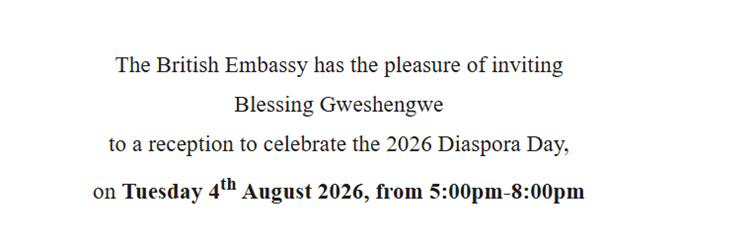
Early last week, I had the honour and privilege of attending the 2026 Diaspora Week Reception at the British Ambassador’s Residence in Harare. It was a pleasure to return to the Residence as a repeat guest (for blogs on my previous visits, see here and here).

As a partner of Zimbabwe Diaspora Week 2026, the British Embassy co-hosted the reception with the Zimbabwe Achievers Awards (ZAA), popularly known as Zimachievers, a globally recognised platform that celebrates the excellence, innovation and impact of Zimbabweans across the world. The reception, which was an integral part of the broader programme of activities marking Diaspora Week 2026, brought together a diverse group of participants, including diplomats, government officials, investors, entrepreneurs, innovators, professionals, community builders and researchers/academics – many of whom were former or current members of the Zimbabwean diaspora. Distinguished guests included Mudiwa Hood (entrepreneur and author), James Mashakada ( the recipient of the 2026 Member of the Order of the British Empire (MBE), in recognition of outstanding services to race equality, diversity, and inclusion in the UK Civil Service), the Kenyan Ambassador and the Deputy Minister of Youth Empowerment Development and Vocational Training, Honourable Kuda Mupamhanga.

Photos credits, UK in Zimbabwe & Jameson Mashakada
It was particularly inspiring to listen to the opening remarks delivered by British Embassy officials and ZAA Chief Executive Officer Caroline Mude, as well as the keynote address by Honourable Kuda Mupamhanga. Collectively, their speeches conveyed a timely message: the Zimbabwean diaspora should be recognised not merely as a source of remittances, but also a strategic development partner whose knowledge, expertise, networks and investments could help to accelerate Zimbabwe’s national development, a theme that forms the basis of the reflections that follow.
Remittances: A Lifeline for Families and the Nation
The flow of diaspora remittances to Zimbabwe, as highlighted by the Deputy Minister and also reported here, now exceeds US$2 billion annually, representing a significant increase over recent years. The remittances come primarily from South Africa, the UK , USA, Canada , Australia and Botswana. At household level, these remittances play a crucial role in financing basic needs (food, education, healthcare etc), household assets and housing construction. Beyond their impact on household welfare, diaspora remittances have become Zimbabwe’s second-largest source of foreign currency after export earnings, making a significant contribution to macroeconomic stability and economic growth in the country (read more here and here). The Deputy Minister also called for Zimbabwe to create an enabling environment that encourages the investment of remittances in agriculture, mining, housing and other productive sectors, even as they used to support household consumption.
Beyond Remittances: Harnessing the Diaspora for National Development
The Zimbabwean diaspora is much more than a source of remittances. It constitutes an important reservoir of human capital whose knowledge, expertise, experience, innovation, entrepreneurship and international influence could be harnessed for national development. This was certainly the overarching theme running through every speech and conversation at the reception. The Deputy Minister emphasised that it is the Government’s desire for Zimbabweans in the diaspora not to be left behind in the country’s development agenda. Likewise, British Embassy officials spoke of the remarkable breadth of talent and experience represented at the 2026 Diaspora Week Reception. They recognised the enormous influence of the Zimbabwean diaspora and its unique ability to “build bridges where governments and institutions alone cannot”, connecting people, markets and ideas. These contributions are evident across a wide range of sectors, including healthcare, education, research, entrepreneurship, business, investment and innovation. The Chief Executive Officer of the Zimbabwe Achievers Awards (ZAA), Caroline Mude, further reinforced this message by highlighting the organisation’s mission of connecting, celebrating and mobilising Zimbabweans globally while shining a light on their excellence, innovation and impact. In short, the reception conveyed a clear and compelling message: the Zimbabwean diaspora is a strategic reservoir of human capital whose potential extends far beyond remittances, and meaningful efforts are being made to harness this potential for Zimbabwe’s national development.
From the UK to Asia: My Personal Diaspora Experience
I was once part of the Zimbabwean diaspora. Between 2011 and 2012, I lived in Brighton and Hove in the UK, where I pursued an MA in Poverty and Development at the Institute of Development Studies (IDS), University of Sussex, ranked first in the world for development studies. There, I developed a deeper understanding of poverty and development and acquired rigorous research and fieldwork skills that became the foundation of my subsequent academic and professional journey. This journey later took me to Southeast Asia, where I pursued academic and professional opportunities in Brunei Darussalam, Cambodia and rural Malaysia. Living and working in these diverse contexts broadened my perspective on development and, most importantly, convinced me that poverty is not an inevitable condition, to which we must resign ourselves, but one that can be eradicated, a conviction I explore in greater depth in my forthcoming book on poverty. Now that I am back in Zimbabwe, and even as I continue to work across Africa and Southeast Asia, I see the knowledge, expertise and international experience gained through my diaspora journey as valuable assets that could contribute to development, not only in Zimbabwe but also across the regions that remain the focus of my professional work.
The speeches and conversations at the British Embassy’s Diaspora Week Reception reinforced an important lesson: the future of Zimbabwe’s development should not be measured solely by the remittances that its diaspora community sends home, but also by the knowledge it shares, the partnerships it builds, the investments it makes and the ideas it brings back. Harnessing this broader contribution presents Zimbabwe with significant opportunities to advance national development. As Zimbabwe seeks to accelerate inclusive and sustainable development, recognising and strategically engaging its diaspora community as a development partner, rather than merely a source of remittances, will be essential to unlocking its full potential.

