
Last week, I was revising Chapter One of my book on poverty eradication, which I submitted to a University Press for consideration along with the book proposal. The book manuscript, comprising 10 chapters, is now 100% complete in its first draft. As I was revising the chapter in question, I came to appreciate how our thinking about the fight against poverty has shifted over time, from poverty alleviation or reduction to eradicating poverty or ending it altogether. Although this shift in thinking, as the late Martin Ravallion explained here and here , can be traced back to the late eighteenth century, it is only quite recently that it has gained significant traction and policy support at both national and global levels. At national level, for example, the United States declared a “war on poverty” in the 1960s, while Brunei Darussalam went further in 2008 by explicitly declaring a “Zero Poverty” aspiration by 2035, as can be seen here. Similarly, several countries across the globe are working towards ending poverty in all its forms by 2030 (Sustainable Development Goal 1).
Is ending poverty possible?
There is a long-standing argument that poverty will always exists. I vividly recall, for example, being asked this question during my PhD qualifying exam presentation at Universiti Brunei Darussalam (I shared the story of my PhD here). I was also asked the same question by some Bruneians during my fieldwork on poverty in Brunei. Interestingly, renowned Poverty and Development Researcher Professor Robert Chambers of the Institute of Development Studies at the University of Sussex was confronted by the same question, as he highlighted in his book Provocations for Development (see page 203 of this book, which you can download here for free). Indeed, if poverty still exists in wealthy countries such as the United States, Britain, Switzerland and Luxembourg (see here, here, here and here), it is not unreasonable to wonder whether poverty can actually be eradicated.
I personally believe, as I shared here, that ending poverty in our lifetime is possible. This conviction has long shaped my contribution to understanding and eradicating poverty in both low-income and wealthy countries. I have also shared here the 10 (sure) ways of losing the war on poverty. As a result of my work on poverty, I was commissioned by SAGE’s International Journal of Community and Social Development to contribute a think piece on progress towards ending global poverty, with a view to informing debates on ending poverty at the Second Summit on Social Development (Doha, 2025). In this think piece (freely available here, and which I also blogged about here), I gave seven (7) reasons why the world is off track to achieving the No Poverty SDG by 2030 and discussed what needs to be done to get back on track.
As I was developing my book’s central argument, informed by this conviction that it is possible to end poverty , I concluded that doing so, at either national or global level, requires three conditions:
A firm conviction that ending poverty is actually achievable
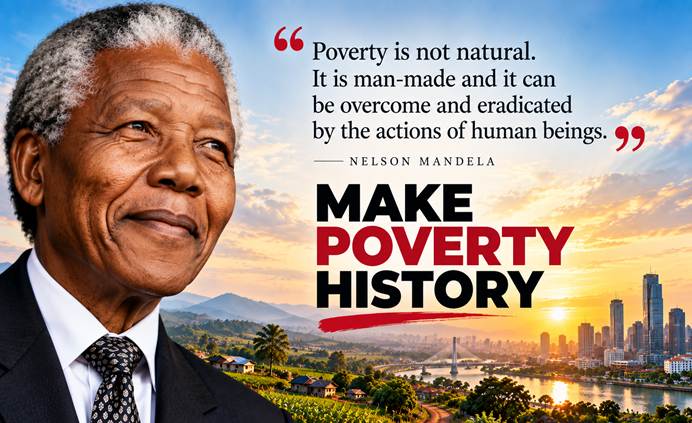
In his address at the Make Poverty History campaign in London, the late former South African President Nelson Mandela rightly argued that poverty is not natural but man-made and can therefore be eradicated through human action. Indeed, poverty is neither an inevitable nor a permanent condition of human society. A firm conviction where ending poverty is concerned means having a deep and shared belief that poverty eradication is possible, desirable and worth pursuing. Such a conviction exists when individuals and institutions across society genuinely believe that their society can be free from poverty and recognise that they each have complementary roles to play in making this aspiration a reality. This conviction matters because a society that does not believe poverty can be eradicated is unlikely to organise itself around achieving its eradication. It is for this reason that every society aspiring to end poverty should ask itself a fundamental question: Do we genuinely believe that poverty can be eradicated?
A sustained commitment
Having a firm conviction that poverty eradication is achievable is necessary but not enough, however, as conviction should be translated into sustained action. This entails setting a clear target – say, zero poverty or ensuring that no one lives in any form of poverty – within a defined timeframe, making poverty eradication a top national priority and devoting the attention, resources and actions necessary to this end. Indeed, within any given society, sustained commitment is evident when ending poverty remains a national priority over time; adequate resources are consistently devoted to it; appropriate policies, programmes and institutions are established and strengthened; progress is regularly assessed and government, the private sector, civil society, communities and families play complementary roles in achieving the poverty eradication goal. As such, a society needs to ask itself: “Are we doing what it takes, for as long as it takes, to eradicate poverty?”
A clear understanding of the poverty to be eradicated
A society may well have a firm conviction that ending poverty is possible and commit itself to achieving it, but even this is not enough. We cannot eradicate what we do not clearly understand. This is one of the seven reasons I proffered to explain why the world is off track to achieving the ‘No Poverty’ goal by 2030 in my article (Ending Global Poverty by 2030 is Off Track: Gaps and Actionable Strategies) published by SAGE. A society should therefore have a clear understanding of the poverty it seeks to eradicate. It should be clear about what poverty it actually experiences; what drives and sustains it; its different dimensions or forms; its complexity; how it differs among people, communities and contexts; who is poor, very poor and near-poor; who is vulnerable to falling into poverty or falling further into it, and why; and the poverty myths or commonly held misconceptions that inevitably exist in societies, particularly wealthy ones. Equally important is being clear about what it would mean, in practical terms, to say that poverty has actually been eradicated. Such clarity matters because it helps a society determine appropriate poverty-eradication actions and ensure that no one is left experiencing any form of poverty. It is therefore encouraging to see a real desire for greater clarity about what poverty actually is, as reflected in the interest generated by our scholarly article, Defining the Characteristics of Poverty (freely available here), which has been downloaded/viewed more than 74,000 times since 2020. This paper was drawn from my PhD thesis, and I shared the story behind its development here. Every society aspiring to end poverty should therefore ask itself: How well do we actually understand the poverty we seek to eradicate?
In summary, then, aspiring to have a society, country or world without any form of poverty may seem ambitious, especially when poverty has remained stubbornly persistent throughout human history and continues to be an issue, even in wealthy countries. This should not, however, be taken to mean that poverty eradication is impossible. If we are serious about moving beyond alleviating or reducing poverty with a view to ending it, then every society needs to reflect on three fundamental questions: Do we genuinely believe that poverty can be eradicated? Are we doing what it takes, for as long as it takes, to eradicate poverty? And How well do we actually understand the poverty we seek to eradicate? These questions speak respectively to the conviction, sustained commitment and clear understanding of poverty, which are the conditions necessary for poverty eradication to become a reality.

