
As I stressed earlier in a blog post here, despite the unprecedented global momentum behind championing clean cooking, the challenge of sustained adoption remains formidable today, just as it was during the first wave of improved cookstove programmes in the 1970s and 1980s (see, for example, here, here, here and here). The adoption that counts, as I argued in the same post, is the organic one, rather than the one driven by incentives or close and sophisticated monitoring of clean cooking programmes by service providers. The persistent challenge of sustaining clean cooking adoption prompted me to delve into the related literature in a bid to understand why it has endured for decades. Historically and today, households have often been portrayed as not fully appreciating the benefits of clean cooking, leading programmes to prioritise awareness raising about these benefits. Despite these efforts, however, sustained adoption has remained far below expectations (as can be seen here and here). At the same time, this long-standing clean cooking adoption challenge has also been attributed to the failure to account for local cooking needs, cultural preferences and broader social and economic realities , as well as limitations in some clean cooking technologies. Although some shortcomings have been addressed in significant ways, sustained adoption remains a major challenge, with many households practising stove or fuel stacking rather than making a complete transition to clean cooking.
What, then, is the way forward? It is clear that people adopt better lives, not necessarily better clean cooking technologies. This is not to suggest that clean cooking technologies are not important, because they are indeed essential. Rather, it reflects a fundamental aspect of human behaviour: that when the life-transforming potential of a technology is clear and tangible, people are far more likely to adopt it. As I argued in my previous blog post, therefore, clean cooking needs to be embedded within society’s pursuit of a good life so that its contribution to improving people’s lives becomes clear and meaningful to those it is intended to serve. The next question, then, is how to embed clean cooking within this broader societal pursuit. In my recently completed systematic review, I argue that the starting point is a better understanding of how clean cooking contributes to the eradication of poverty in all its forms. Building on that understanding, I propose four recommendations that make the contribution of clean cooking to poverty eradication more visible and meaningful to people, encouraging its organic and sustained adoption. The recommendations are explained hereafter:
First, embed multidimensional poverty eradication at the centre of clean cooking programme design. Multidimensional poverty eradication should be the primary objective guiding the design of clean cooking programmes rather than an incidental co-benefit. This begins with adopting the right definition of poverty, because an inaccurate definition inevitably leads to programmes that are not as effective as would be desired in addressing poverty in all its dimensions, as I argued in a scholarly article found here. The definition that should guide clean cooking programme design is not poverty as a lack of income or the inability to meet basic needs, therefore. Rather, it is poverty as Robert Chambers defines it: “bad conditions or experiences of life” or, as Amartya Sen similarly conceptualises it: deprivation of basic capabilities or opportunities, reflected in undesirable conditions or experiences of life. This should be accompanied by a thorough understanding of the dimensions of poverty and the barriers to poverty eradication experienced by the communities targeted for clean cooking interventions, and the subsequent alignment of programme design with those realities. The analytical framework below can be used in embedding clean cooking in poverty eradication at the design stage.
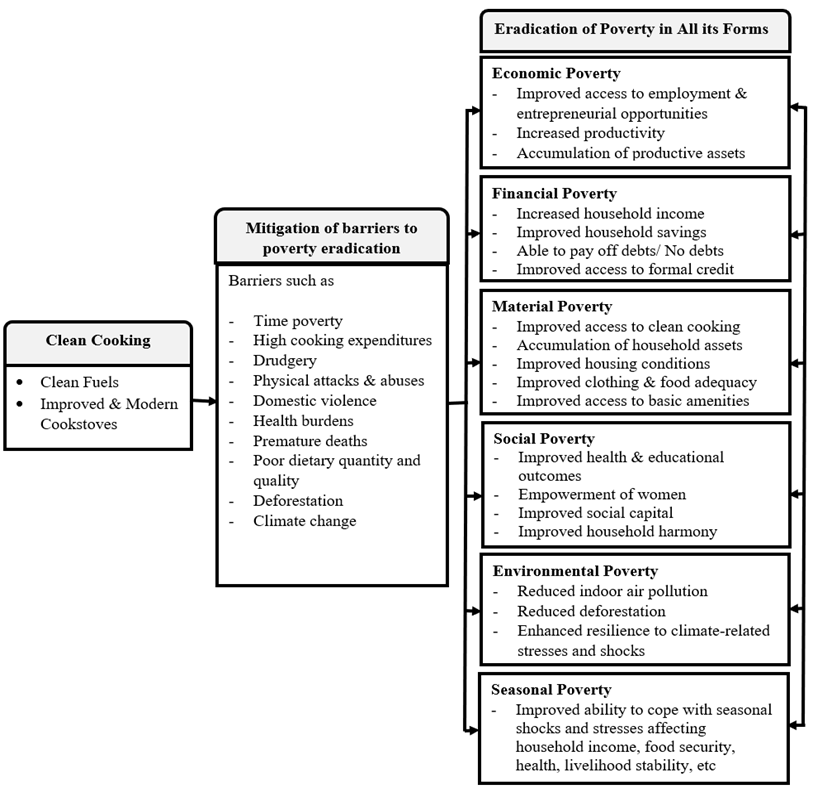
The second recommendation is to intentionally convert the opportunities created by clean cooking into multidimensional poverty eradication outcomes. Clean cooking mitigates key barriers to poverty eradication (listed in the framework above), thereby creating opportunities for multidimensional poverty eradication. Unless these opportunities are intentionally harnessed, however, their full poverty eradication potential may not be realised. The additional time created through clean cooking, for example, may simply become what Robert Chamber describes as the ‘poverty of more time’ (another form of time poverty) if households have no meaningful opportunities to use that time productively. Following the embedding of multidimensional poverty eradication into the design of clean cooking initiatives, these initiatives should therefore be connected to, reinforced by or complemented with other interventions that enable the opportunities created through clean cooking to be transformed into lasting improvements in people’s lives.
The third recommendation is to prioritise the poorest households and women in clean cooking initiatives. Cooking poverty, as I shared here, is now the new face of global poverty. It disproportionately affects the poorest households and women. Consequently, these households and women bear the greatest burden of the key barriers to poverty eradication that clean cooking helps to mitigate. They therefore stand to gain the most from clean cooking interventions. Emerging evidence from China suggests that adoption among these groups increases when clean cooking interventions are integrated with broader poverty eradication efforts (read here and here, for more). Prioritising these groups is therefore essential not only for maximising the contribution of clean cooking to eradicating multidimensional poverty but also promoting sustained household adoption.
The fourth recommendation is to measure the success of clean cooking programmes in terms of their contribution to multidimensional poverty eradication, not merely by stove distribution and adoption. Measuring the number of stoves distributed and the extent of sustained household adoption remains essential, but these indicators alone are insufficient to determine programme success. Programme evaluation should also assess the extent to which sustained adoption has mitigated key barriers to poverty eradication, how the opportunities created through mitigating these barriers have translated into the eradication of multidimensional poverty, and, ultimately, the extent to which clean cooking has improved people’s quality of life. In other words, the true measure of success is not merely how many stoves are distributed and sustainably adopted, but the extent to which clean cooking contributes to lasting multidimensional poverty eradication. Such an approach would enable governments, private companies, non-governmental organisations and other stakeholders to clearly demonstrate the true development impact of clean cooking, generating evidence to continuously improve programme effectiveness.
As I argue in my systematic review, sustained adoption is essential if clean cooking is to meaningfully catalyse poverty eradication. This persistent adoption challenge, as I stressed here, benefits no one, since investors lose confidence or withdraw their investments, governments and NGOs struggle to demonstrate meaningful policy impact and millions of households remain trapped in multidimensional poverty. The recommendations presented above seek to change this by re-positioning clean cooking as a catalyst for poverty eradication, grounded in a deeper understanding of how it contributes to improving people’s lives, which I demonstrated with practical examples in my systematic review. This review has been submitted for publication and is currently under review, and I invite you to read my earlier blog post on how clean cooking contributes to the eradication of poverty in all its forms, accessible here.
 Blessing Gweshengwe PhD