
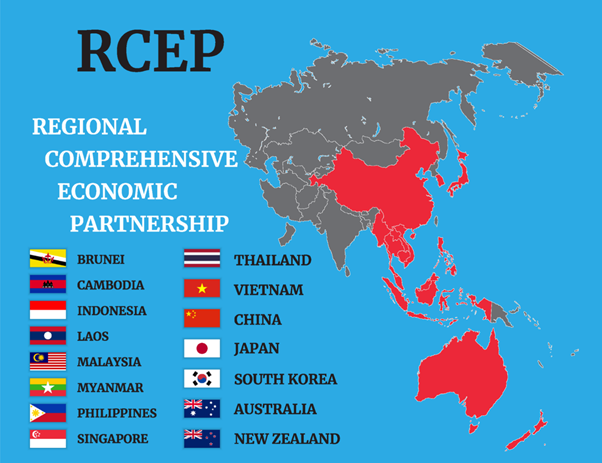
Recently, I had the incredible opportunity to contribute a chapter to a book on the Regional Comprehensive Economic Partnership (hereafter, RCEP) and development in the ASEAN region, published by Bentham Science Publishers. This book project was spearheaded by the esteemed Institute of Policy Studies at the Universiti Brunei Darussalam. The RCEP is the largest and most comprehensive regional free trade bloc. It comprises 15 countries: New Zealand, Australia, China, South Korea, Japan and 10 ASEAN countries (Brunei Darussalam, Malaysia, Singapore, Indonesia, Thailand, the Philippines, Myanmar, Cambodia, Laos PDR and Vietnam).
In the aforementioned chapter, I examined whether the RCEP could contribute to the achievement, by ASEAN countries, of the Sustainable Development Goal (SDG) 1 of no poverty. This was necessitated by the fact that an economic partnership could contribute significantly to poverty eradication, but its success in doing so depends on several factors, such as the scope of the partnership, the structure of participating economies and the ability of the poor to reap benefits from it. Given such a scenario, what are the implications of the RCEP achieving SDG 1 in ASEAN countries?
It goes without saying that RCEP holds enormous potential to help eradicate poverty in ASEAN countries. In my book chapter, I advanced six compelling reasons to support this claim, which include:
The RCEP has the capacity to significantly boost economic growth in ASEAN countries. Economic growth is key for poverty eradication, and, as I stressed in the chapter, a country does not even need a high economic growth rate to achieve a substantial poverty reduction. For example, an economic growth rate of 1.10% translated to significant poverty eradication in Nepal. Due to its scope – which includes trade liberalisation, economic and technical cooperation, competition promotion, and dispute settlement, RCEP’s ability to boost economic growth in the ASEAN countries is indisputable. Of course, a country’s initial levels of economic development and income inequality are decisive in determining whether economic growth results in significant poverty reduction. Required, as highlighted in the chapter, is a combination of a high initial level of economic development and a low initial level of income inequality. All ASEAN countries meet this condition, as is demonstrated in the chapter.
The partnership enhances real convergence, that is, the catching or levelling up of the standard of living of poor countries to that of rich countries. In addition to spurring economic growth, the RCEP promotes the flow of capital from capital-rich countries such as Australia, New Zealand and China to capital-poor countries such as Laos PDR and Cambodia. This will enable ASEAN countries to level up their living standards, eradicating poverty in the process.
Sharing of policy experiences – some countries in the RCEP have outstanding economic and social policy experiences relating to policy design, implementation, challenges and reforms. Owing to its strong economic and social policies, Australia, for example, has a very high standard of living and was able to weather the adverse effects of the COVID-19 pandemic. Meanwhile, New Zealand, a pioneer welfare state, successfully reformed its welfare policies in response to fiscal and other challenges, resulting in a sustained high standard of living within the country. China, too, implemented exceptional economic and redistributive policies that resulted in unparalleled poverty reduction. Lastly, as I also blogged here, Brunei is successfully eradicating poverty, owing to its generous and resilient welfare system. These policy experiences are invaluable to ASEAN countries, as they can draw insights that would enable them to meaningfully eradicate poverty, especially in the aftermath of the COVID-19 pandemic.
Having said this, however, it should be recognised that the RCEP’s contribution towards poverty eradication in ASEAN countries is far from smooth. The COVID-19 pandemic, for instance, has negatively impacted economies and worsened poverty in most ASEAN countries. Moreover, countries like Myanmar, Thailand and Malaysia have experienced their share of political crises.
When all is said and done, the RCEP could contribute significantly to poverty eradication in ASEAN countries, helping the countries to achieve SDG 1. I invite you to learn more about this as well as the challenges and the recommendations on how to address them from my chapter found here.
 Blessing Gweshengwe PhD