
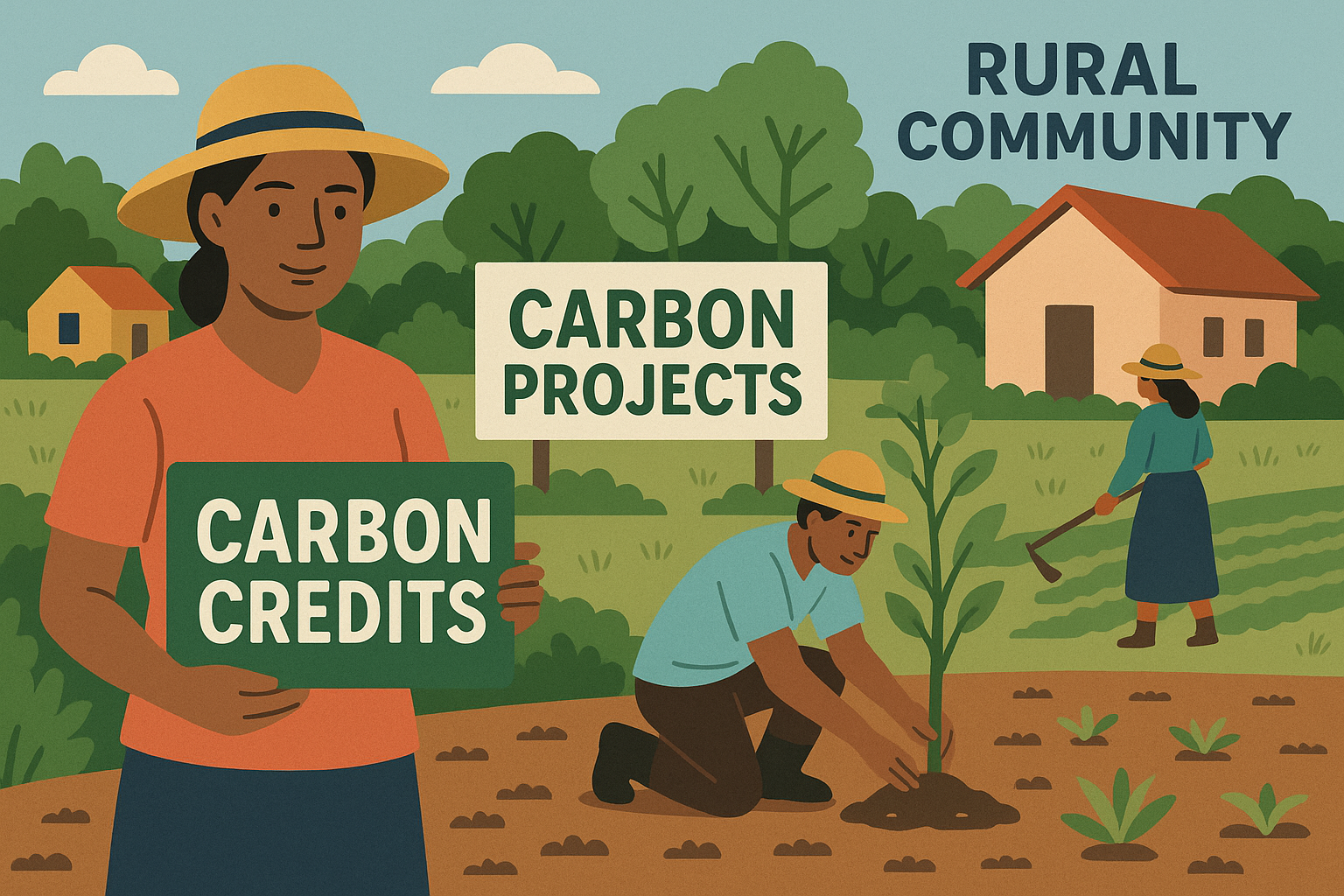
As the urgency of the global climate crisis intensifies, carbon credits are emerging as one of the most promising market-driven solutions to climate change. However, behind every carbon credit lies a rural community, often in the Global South, where poverty is deeply entrenched. These communities not only provide a conducive environment for implementing carbon projects but are also tasked with implementing them. There is no doubt that carbon projects possess immense potential to contribute to the eradication of poverty in all its forms, as I have discussed in previous blog posts (here and here) and in my open-access scholarly article (here). In practice, however, this potential remains largely unrealised within communities (see, for example, here, here and here). A key challenge lies in the absence of clearly defined and enforceable mechanisms to ensure that rural communities receive meaningful and lasting benefits. Zimbabwe has tackled this challenge with its newly established National Carbon Framework, outlined in Statutory Instrument 48 of 2025 (Carbon Trading General Regulations, 2025). Against this background, this blog post discusses how Zimbabwe’s Carbon Framework could contribute to ending rural poverty within the country, potential challenges and solutions to these challenges.
Zimbabwe’s Carbon Framework and Ending Rural Poverty
Poverty in Zimbabwe, as I shared here, is predominantly rural. In 2019, for example, nearly 90 % of the people in extreme poverty in the country were living in rural areas (World Bank, 2020). Given the enormous potential of carbon projects to contribute to the eradication of poverty in all its forms, rural areas are uniquely poised to benefit. In Zimbabwe, carbon projects are predominantly implemented in rural areas, with notable examples including improved cookstove, afforestation and reforestation (e.g. Kariba REDD+) initiatives. The country’s carbon framework clearly stipulates how these carbon projects should benefit communities, ultimately contributing to poverty eradication.
How the framework mandates carbon projects to make meaningful, tangible and measurable contributions to improving lives in communities is summarised as follows:
Mandatory Community Investment: As the framework stipulates, at least 20% of the total investment must directly benefit local communities through:
- Local recruitment, training and employment
- Infrastructure development
- Education, health and sanitation
- Environmental restoration
- Food security
- Gender equality
- Clean energy and water access – which are treated as a priority: at least 50% of the community investment must be directed towards supporting access to clean energy and potable water.
Development Outcomes as Entry Criteria: Projects must clearly demonstrate sustainable development benefits they expect to deliver, and these benefits must be both credible and compelling.
Monitoring and Reporting: Project proponents must demonstrate the expected sustainable development benefits of their project by completing the Sustainable Development Tool (SDT) during the Project Idea Note (PIN) stage. At the Project Design Document (PDD) stage, they are also required to submit a detailed investment and monitoring plan, showing how these benefits will be delivered and tracked throughout the project’s lifespan, and to include an exit strategy to ensure the benefits are sustained beyond the project’s end. Moreover, the project proponents are required to submit a Sustainable Development Report (SDR) within 12 months of project implementation. This ensures accountability and enables the tracking of real community benefits from the outset.
High-Risk Safeguards: Certain project types can be classified by the Zimbabwe Carbon Markets Authority (ZiCMA) as high-risk and are therefore subject to additional requirements. Clean Cookstove Projects, for example, are classified as high-risk and must meet strict conditions.
Alignment with National Development Plans & SDGs: Zimbabwe aims to become an upper-middle-income country by 2030, in line with its Vision 2030 and also strives to achieve Sustainable Development Goal 1 – ending poverty in all its forms by 2030. In pursuit of these worthwhile goals, the country remains committed to leaving no one behind, especially those living in rural communities. Accordingly, all carbon projects are required to align with the country’s national development plans and the 2030 Agenda for Sustainable Development.
Compliance: Requiring all carbon projects within the country to make meaningful, tangible and measurable contributions to sustainable development is non-negotiable. Projects that do not meet sustainable development requirements or fail to provide robust monitoring frameworks will be denied approval by the ZiCMA. This is not to suggest that Zimbabwe is making it difficult or unattractive to invest in the country’s carbon sector. It is, rather, championing ‘carbon credits with a conscience’ – not just prioritising offsetting emissions or making profits but also tangible social impact. This is crucial, as communities on the ground often bear the brunt of the carbon burden without deriving any real benefits, as highlighted earlier and also here and here. Carbon developers and sellers also stand to gain. Carbon credits from projects that deliver additional benefits (tangible social impact) are considered premium and typically command higher prices, as explained here and here. The carbon market is increasingly shifting toward ‘Carbon Credits+,’ where social, economic and environmental co-benefits matter. Developers can also earn more by claiming SDG credits. Lastly, social and environmental issues are, as discussed by Dambisa Moyo in her book ‘How Boards Work’, becoming increasingly topical in corporate boards. Accordingly, carbon credits with co-benefits present a much-needed opportunity for corporations to meet their ESG goals, as seen here and here, for example.
These sustainable development requirements for all carbon projects in Zimbabwe hold significant potential to help eradicate rural poverty in the country. By way of example, training, employment, health and education opportunities emanating from carbon projects could enhance household human capital and income levels, which are key in helping households graduate from material and other forms of poverty. Moreover, requiring that at least 50% of the community investment be directed towards enhancing access to clean energy and safe drinking water is both strategic and commendable. 91.1 % of households without access to electricity within the country are in rural areas, and rural women and girls travel an average of 4 Km and spend an average of 6 hours every day searching for safe drinking water. Insisting that the lion’s share of the community investment be allocated to clean energy and potable water would, therefore, greatly improve the quality of life for women and girls, which is key to ending all forms of poverty.
The framework has also opened the door for meaningful private sector participation in the fight against poverty, a long-overdue gap in poverty eradication that requires urgent attention, given recent aid cuts. In Zimbabwe, as in many other parts of the world, poverty eradication has traditionally been the responsibility of governments and charitable organisations. Although the business sector has been involved, its role has largely been limited to Corporate Social Responsibility (CSR) initiatives. However, with the introduction of the carbon framework, the private sector is now poised to play a more substantial role in poverty eradication, an important step towards bridging the funding gap caused by declining aid. This shift is particularly promising, given the significant growth of the carbon market, especially the Voluntary Market, despite the challenges, as explained here and here. What stands out is the commitment to human dignity, as the framework shifts the role of communities from passive beneficiaries to active partners in development.
Potential Challenges and Solutions
Several challenges may hinder the country’s efforts to eradicate poverty through the national carbon framework. Below are some of them, together with solutions to overcome them.
Integrating poverty eradication into carbon projects constitutes a challenge in itself:
Ending poverty (SDG 1) is the top priority of the 2030 Agenda for Sustainable Development and aligns closely with Zimbabwe’s Vision 2030. If carbon projects are to align with this particular goal and contribute meaningfully to its realisation, poverty eradication has to be integrated from project design through to completion. This is precisely where most carbon projects tend to fall short. As I discussed in my article on the contribution of Nature-based Solutions to poverty eradication (available here), it is typically assumed that these projects will naturally help to eradicate poverty. Simply planting trees or distributing improved cookstoves or solar products does not necessarily translate to poverty eradication, despite the evident benefits. In cases where poverty eradication is considered in these projects, the approach is often incorrect. Many projects report contributions such as increased household income, improved livelihoods, job creation, or asset accumulation. Although these are important indicators of progress, they are not in themselves sufficient to claim true poverty eradication, given the characteristics and causes of poverty.
In its quest to address this challenge, Zimbabwe’s carbon framework has attempted to ensure that community investment is directed toward diverse aspects of sustainable development, which translates to dimensions of poverty, although not all. To complement these efforts, carbon projects need to go beyond compliance and intentionally integrate poverty eradication across every stage of the project life cycle, from design and implementation to monitoring and benefit sharing. This requires the adoption of an approach that acknowledges what poverty truly is, as discussed in Gweshengwe and Hassan (2019), the underlying characteristics of poverty, as detailed in Gweshengwe and Hassan (2020), and the various causes of poverty. Project design needs to be grounded in a clear understanding of the specific nature of poverty within a particular target community. This also requires using the right approach to accurately ascertain the local dimensions and drivers of poverty.
Measuring the contribution made by carbon projects to poverty eradication is also a potential challenge: To truly understand our progress in eradicating poverty, we must pay close attention to how we measure it. Unfortunately, there is no consensus on how poverty should be measured, and the existing poverty measures are not perfect. Poverty needs to be measured regardless, and, as I argued here, a poverty measure should at least acknowledge the characteristics of poverty. In Zimbabwe, poverty is primarily measured using an income-based approach, as I highlighted here. Even the United Nations largely assesses countries’ progress toward achieving SDG 1 (No Poverty) using an income-based indicator. The SDG framework also leaves room for countries to adopt a multidimensional approach, given that SDG 1 aims to eradicate poverty in all its forms. However, like many countries, Zimbabwe is yet to have an official multidimensional poverty measure or definition. Reporting contributions toward poverty eradication or SDG 1 in this context would involve using Zimbabwe’s official poverty line and/or SDG Target 1.1. This, however, would not accurately reflect the contribution of carbon projects to ending poverty, given the multidimensional and complex nature of poverty. Additionally, carbon project developers are likely to emphasise numerical data, such as the number of jobs expected to be created or already created and the expected increase in household income, over the meaningful impact in their reporting. Although such indicators are important, they miss the deeper, more meaningful impact on people’s lives. Having a job does not necessarily mean a good life, since it is quite common for such projects to have the working poor (about whom you can learn more in my blog post here), and having an increased household income does not necessarily translate into improved quality of life, as we have found in our study of poverty in Brunei, see here and here.
What is required, therefore, is the use of a poverty measure or approach that fully acknowledges the multidimensional and complex nature of poverty, as well as what intrinsically matters to people—their ‘beings and doings.’ This tool or approach should be applied from the baseline stage of the programme, and carried through its design, monitoring, and evaluation. It will enable the reporting of the actual impact of carbon projects on people’s lives, with a focus on what truly matters to them.
A silo mentality is also a critical barrier to fully capitalising on the poverty eradication opportunities associated with carbon projects. At an individual level, professionals often operate within the boundaries of their own specialisations, shaped by their training, preferences and even unconscious biases. This can make it difficult to think beyond their field and integrate poverty considerations into carbon project design and delivery. At the institutional level, differing expectations regarding contributions to a company’s vision and mission, coupled with variations in legal structures and departmental mindsets, can further fragment efforts. Yet, for carbon projects to meaningfully contribute to poverty eradication, collective engagement of multiple departments across the organisation is essential.
If these silos are not dismantled, Zimbabwe risks missing out on the real benefits that communities could derive from carbon projects. A practical solution lies in intentionally mainstreaming poverty eradication into these projects through the collaboration of professionals from diverse disciplines, departments, and even organisations. This kind of cross-sectoral teamwork ensures that different perspectives – social, environmental, economic and technical – are brought to the table. Equally important is a conscious effort by team members to acknowledge their own blind spots and biases. Only by fostering this kind of inclusive, reflective and interdisciplinary collaboration is it possible to design and implement carbon projects that contribute meaningfully to ending poverty in all its forms.
In conclusion, Zimbabwe’s carbon framework is a promising step towards linking climate action with ending rural poverty. Real impact, however, depends on more than compliance: it demands intentional design, effective measurement and inclusive collaboration. With the right approach, carbon projects could indeed go beyond offsets and become engines of rural transformation.
I am currently working on a perspective paper that will offer a more detailed analysis and expanded reflections on the issues raised in this blog post. Stay tuned for deeper insights into how carbon markets can be leveraged to drive sustainable and inclusive development in Zimbabwe, particularly in rural areas.


Pingback: Carbon projects could indeed help end poverty, but only if they are rooted in the right poverty worldview – Blessing Gweshengwe PhD